Good Motorcycle Shipping Preparation Starts Before Pickup
Preparing a motorcycle for cross-country shipping involves more than washing it and handing over a key. You need an accurate booking, a motorcycle that can be handled safely, a documented condition record, and a clear understanding of who is arriving to collect it. Missing any one of those pieces can turn a straightforward handoff into a delay or a disagreement.
Queue verification is a useful name for checking where your shipment stands before pickup: Is the order recorded correctly? Is carrier assignment still pending? Has the licensed broker assigned a carrier? Has a pickup window been communicated? The phrase is not a universal industry status, so ask what any status label means rather than assuming that “in queue” means a truck is already scheduled.
TankWorldWide is a vehicle and equipment transport marketplace acting as an agent for a licensed broker. It is not the carrier or the broker itself. Customers receive a fixed instant price, pay a deposit online, and pay the balance directly to the driver at delivery. There is no escrow, and carrier assignment is broker-managed; customers do not choose the carrier.
The checklist below connects booking verification with practical motorcycle preparation, from the information you submit through the inspection at your destination.
Verify the Booking Before Preparing for a Specific Pickup
Check the motorcycle details against the actual bike
A carrier needs more than a make and model to plan safe loading. A stock touring motorcycle, a lowered cruiser, and a three-wheel conversion may require different equipment and space. Review your order confirmation and correct missing or inaccurate information before dispatch planning advances.
- Identification: Confirm the year, make, model, and requested identifying information.
- Configuration: Disclose a sidecar, trike conversion, extended forks, unusually wide handlebars, or other dimensional changes.
- Accessories: List installed hard luggage, tall windscreens, crash bars, and other equipment affecting size or handling.
- Condition: State whether the bike starts, rolls freely, steers, and brakes. These are separate questions.
- Loading limitations: Mention low ground clearance, locked wheels, damaged controls, fluid leaks, or anything that makes ordinary handling unsafe.
- Locations: Verify street addresses, contact numbers, access restrictions, and the person authorized to release or receive the motorcycle.
A non-running bike that rolls and steers is different from one with a seized wheel. Describe the actual limitation rather than simply marking it “inoperable.” For additional motorcycle-specific questions, review the motorcycle shipping FAQ on equipment, crating, and preparation.
Separate order status from carrier assignment
An accepted order does not necessarily mean carrier assignment is complete. Likewise, an assigned carrier does not make every timing estimate a guaranteed appointment. Ask for the current status in plain language and keep the response with your booking records.
| Checkpoint | What to verify | What not to assume |
|---|---|---|
| Order confirmation | The motorcycle details, route, service, fixed price, and payment split are correct. | A driver has already been assigned. |
| Assignment pending | Whether the broker needs additional information or availability from you. | You have a guaranteed position in a first-in, first-out line. |
| Carrier assigned | The assigned carrier identity, expected equipment, and pickup coordination process. | You need to choose or hire a separate carrier yourself. |
| Pickup coordination | The pickup window, contact person, accessible meeting point, and handling requirements. | An estimated arrival time cannot change. |
A useful message is: “Please confirm whether my motorcycle is awaiting assignment or has an assigned carrier, whether you need anything from me, and when I should expect the next update.” That is more actionable than asking only for a queue number.
Confirm the Transport and Handling Requirements
Before removing parts or buying a shipping crate, confirm what the booked service requires. Motorcycle transport may involve open or enclosed equipment, dedicated motorcycle fixtures, pallets, or crating. None of these arrangements should be assumed from the word “shipping” alone.
Ask whether the assigned equipment can accommodate your motorcycle’s dimensions, weight, and ground clearance. Also ask whether you are expected to provide a crate or pallet, whether the carrier supplies any required loading equipment, and who performs loading. Do not build a crate until you have written specifications and confirmation that the arrangement is accepted.
Enclosed equipment reduces direct exposure to road spray and weather, but enclosure is not a substitute for appropriate securement. Open transport does not automatically mean unsuitable handling either. The important question is whether the agreed service and assigned equipment fit your motorcycle. The open versus enclosed transport overview can help frame that discussion, but motorcycle-specific handling still needs confirmation.
Clean and Photograph the Motorcycle Before Handoff
Wash lightly, dry thoroughly, and make existing marks visible
A clean motorcycle is easier to inspect. Remove mud and heavy road grime so scratches, chipped paint, and scuffed components can be seen. Avoid aggressive detailing immediately before shipping; slick tire dressings and slippery seat treatments add no transport benefit. Let the bike dry before covering it for storage while you wait for pickup.
Take photographs in good light after cleaning and before the motorcycle leaves your control. Capture full views from both sides, the front, and the rear, followed by detailed images of vulnerable parts. Save the original files and back them up somewhere you can access at delivery.
- Fuel tank, fairings, fenders, and side panels.
- Mirrors, windscreen, levers, bar ends, and handlebar controls.
- Wheels, visible brake components, fork legs, and exhaust surfaces.
- Hard cases, mounting brackets, crash bars, and other installed accessories.
- Every existing scratch, dent, chip, crack, or loose component.
- Odometer reading and instrument display, where practical.
For an existing defect, take one wider photograph showing its location and one close-up showing its extent. A short walkaround video can supplement the photographs, but it does not replace the written pickup inspection. If the motorcycle is running normally, you can also record a brief starting demonstration; do not operate an unsafe bike just to create evidence.
Match your records to the pickup condition report
The bill of lading or associated condition report should accurately identify the motorcycle and its visible condition. Keep your own copy. Photographs help establish a baseline, but they do not excuse an inaccurate or incomplete handoff document. If the report has an error, ask for a correction before signing rather than relying on a verbal promise to fix it later.
Make the Motorcycle Safe to Handle
Check tires, steering, brakes, and leaks
Check tire pressure against the motorcycle manufacturer’s recommendations. A visibly flat tire can complicate loading and should be disclosed before pickup. Do not overinflate tires for transport or make suspension adjustments unless the manufacturer or an appropriately qualified professional recommends them.
Verify that the steering moves normally and that the brakes function if the motorcycle is represented as operable. Look beneath the bike and around the engine, forks, and brake components for leaks. Report active leaks promptly; do not assume a tray or rag makes the motorcycle acceptable for transport.
Do not conceal a handling problem because the bike only needs to move a short distance onto a trailer. A failed brake, unexpected throttle response, or steering lock that cannot be released can create a serious loading hazard. Ask how the carrier will handle the limitation and whether different equipment is needed.
Follow the confirmed fuel and battery instructions
Fuel requirements depend on the transport arrangement. Many ground shipments call for a low fuel level rather than a full tank, but obtain the specific limit instead of treating a general rule as universal. Leave only the amount permitted and needed for agreed handling. Do not drain fuel at the pickup location or pack a fuel can with the motorcycle.
Do not automatically disconnect the battery. The carrier may need electrical power to release a lock or move the bike, while a particular crating arrangement may have different requirements. Confirm the procedure in advance. Disable alarms or proximity features as instructed, and explain any immobilizer or unusual starting sequence.
For an electric motorcycle, disclose that it is electric and ask for the applicable charge-level and battery-condition requirements. Do not assume gasoline-bike instructions apply. A damaged, swollen, leaking, or overheating battery requires special attention; report any known battery damage before transport is arranged.
Remove Loose Items Without Creating New Problems
Remove helmets, jackets, tool rolls, portable navigation devices, phone mounts that detach easily, and other loose belongings unless their transport has been expressly approved. Empty luggage compartments. An installed hard case and the personal items inside it are not necessarily treated the same way under the shipment terms or insurance coverage.
Ask whether vulnerable removable accessories, such as a tall aftermarket windscreen, should be removed. If removal is appropriate, use the correct procedure, label the fasteners, and keep the parts separately. Do not improvise disassembly on pickup day or leave partially attached components for the driver to manage.
Avoid fitting an ordinary loose cover for transit unless the carrier approves it. Wind movement or trapped grit can cause abrasion, and a cover can obstruct inspection or securement. Similarly, do not tape protective material directly to painted surfaces without checking compatibility. The safest protection plan is one agreed with the carrier before loading.
Verify the Pickup Party and Complete the Handoff
Confirm identity through your established booking contact
Before releasing the motorcycle, compare the arriving carrier and pickup information with the assignment details supplied through the booking process. A driver may use equipment marked differently from what you expected, but an unexplained mismatch is a reason to pause and verify—not to guess.
Contact your established booking contact using the details you already have if the company identity, driver information, or instructions differ. Be especially cautious about last-minute messages directing you to an unfamiliar payment account or asking you to release the bike to an unverified substitute. Verification does not mean selecting a carrier yourself; assignment remains broker-managed.
Prepare a safe meeting point and an authorized representative
A transport truck needs adequate approach space, clearance, and room to load safely. Tell the booking contact about narrow streets, overhead branches, steep driveways, gravel surfaces, gated entrances, or parking restrictions. If your address cannot accommodate the equipment, coordinate a nearby legal, safe meeting point rather than expecting the driver to maneuver into an unsuitable location.
If someone else will release the motorcycle, confirm that this is permitted and provide the representative’s contact details ahead of time. That person should know the bike’s condition, understand any handling limitations, have the required key, and be able to review the pickup paperwork. Do not leave the key hidden on the bike for an unattended collection unless a specific arrangement has been expressly approved.
Discuss securement without taking over the loading job
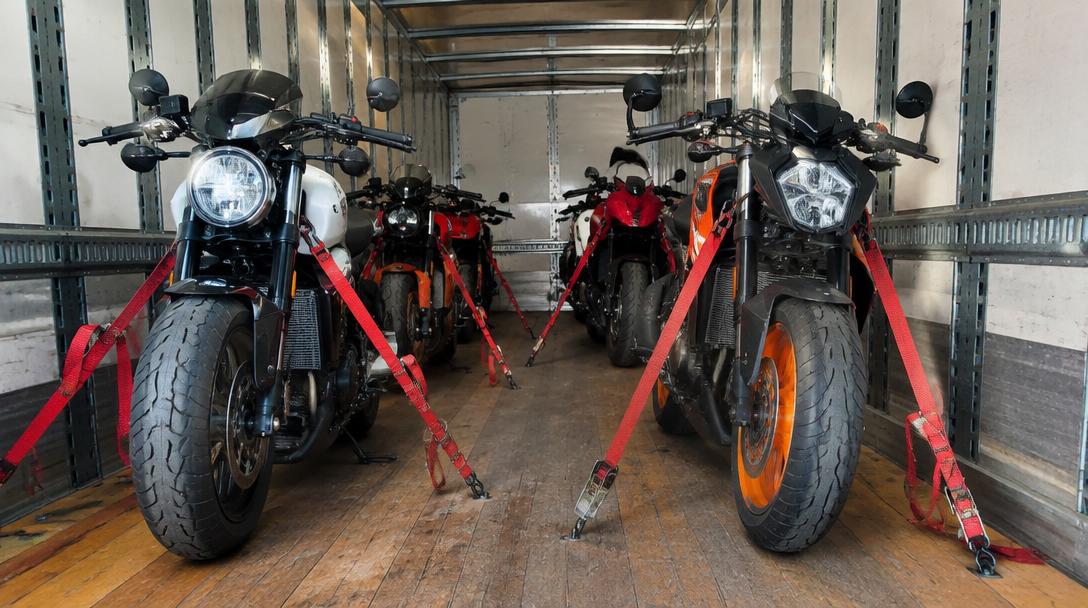
Motorcycles need equipment and securement suited to their design. Ask how the bike will be supported and restrained, particularly if it has delicate fairings, unusual handlebars, low bodywork, or manufacturer-specific tie-down guidance. Share relevant manufacturer instructions before loading begins.
The loading professional should determine the suitable method for the equipment and motorcycle. Do not direct straps around exhaust pipes, brake lines, plastic panels, or other unsuitable components. If you see an apparent contact or clearance problem, raise it before the truck departs. Never climb onto a trailer or attempt to adjust restraints without authorization.
Keep Payment and Coverage Details Clear
With TankWorldWide, you receive a fixed instant price and pay the deposit online. The remaining balance is paid directly to the driver at delivery; there is no escrow. Keep the order confirmation showing the total, deposit, and remaining balance, and confirm the accepted delivery-payment method ahead of time.
Accurate shipment details still matter with a fixed instant price. If you discover that the motorcycle has a sidecar, cannot roll, or differs materially from the information submitted, contact the booking team before pickup and obtain written clarification of any necessary booking changes. Do not leave discrepancies for the driver to resolve at the curb.
Ask what cargo coverage applies to the assigned shipment, including limits, deductibles, exclusions, and treatment of accessories. Do not assume all cosmetic damage, mechanical failures, or personal belongings are covered. A high-value custom motorcycle may require additional discussion before release. The guide to transport coverage, exclusions, and claims explains useful questions to ask without replacing the actual policy terms.
Plan for Cross-Country Transit and Delivery
Cross-country timing can be affected by weather, traffic, other scheduled stops, equipment problems, and driver hours-of-service limits. Arrange your availability around the communicated window rather than building an inflexible travel plan around an early estimate. Ask when updates will be provided and who to contact if circumstances change. The transit-time overview offers further planning context.
At delivery, inspect the motorcycle before signing the condition acknowledgment. Compare it with the pickup report and your photographs, paying particular attention to levers, mirrors, fairings, luggage, exhausts, and visible areas near restraint contact points. Use adequate lighting; if visibility is poor, ask about moving to a safe, better-lit inspection area.
If you find new damage, photograph it, describe it specifically on the delivery paperwork, and promptly notify the appropriate contacts under the shipment and claims instructions. Keep copies of all records. Do not sign a statement that the motorcycle is undamaged if that is not accurate, and do not assume that withholding the balance is the correct claims procedure. Payment obligations and damage reporting should be handled according to the applicable terms.
Before riding away, check for leaks, tire problems, loose parts, and normal operation of the steering and brakes. If something appears unsafe, do not ride the motorcycle. Preserve evidence and arrange an appropriate inspection.
Your Final Queue-to-Delivery Checklist
- Verify the order: Confirm the motorcycle, route, service, fixed price, deposit, and delivery balance.
- Clarify the queue status: Ask whether assignment is pending or complete and whether any information is missing.
- Confirm handling: Resolve equipment, crating, fuel, battery, and non-running requirements before pickup.
- Prepare the bike: Clean it, photograph it, remove loose items, and disclose mechanical or handling limitations.
- Verify the handoff: Confirm the arriving pickup party through your established contact and review the condition report.
- Prepare to receive: Arrange an authorized recipient, a safe delivery location, and the agreed payment method.
- Inspect and document: Compare delivery condition with pickup records and report discrepancies promptly.
The goal is not to perform the carrier’s job. It is to make sure the motorcycle, paperwork, and pickup plan all describe the same shipment. Once you have accurate details ready, you can get a fixed instant shipping price and prepare for a handoff with fewer surprises.